
Integrated Brain & Body Care in Wesley Chapel, serving the greater Tampa area
At Peak Brain and Body, vestibular and balance therapy is not a generic set of exercises – it is a precisely targeted neurological intervention designed to restore how the brain integrates balance, vision, movement, and internal body regulation.
Many of our patients are surprised to learn that although they’ve already completed vestibular therapy elsewhere, the underlying neurological drivers of their symptoms were never fully addressed. That’s why results often plateau or never truly resolve.
This care is for people whose lives have slowly become smaller, quieter, and more restricted than they ever expected.
People who:
Many of these individuals were once active, driven, and engaged. Now, they carefully plan their days around symptoms, recovery time, and uncertainty.
What’s most frustrating is that they’ve done what they were told to do:
Yet something still isn’t right.
If that sounds familiar, it doesn’t mean you failed or that your symptoms are “just something you have to live with.” It often means the right systems were never addressed together.

Traditional vestibular & balance therapy typically focuses on:
While these approaches can be helpful, vestibular therapy on its own is frequently insufficient, especially for individuals with complex or long-standing symptoms.
Why?
Because the vestibular system does not function in isolation.
Balance and spatial orientation depend on:
When these systems are not addressed together, the brain is forced to compensate and symptoms persist.
We are one of very few clinics in the United States that provides vestibular and balance therapy within a fully integrated neurological and physiological care model.
This means therapy is never generic and never done in isolation.
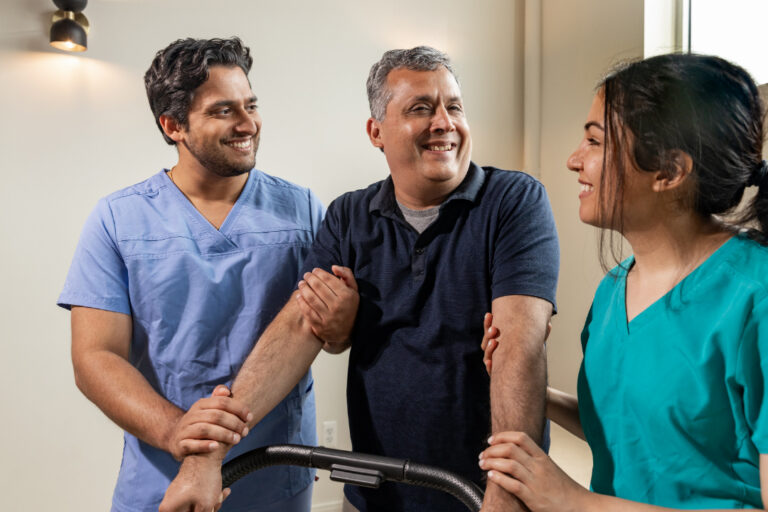
Every aspect of therapy is built around your specific neurological findings, not a standard protocol. This may include:
Each exercise has a purpose, and progression is based on how your nervous system adapts not a preset timeline.
The vestibular system and visual system are deeply interconnected.
If eye tracking, gaze stability, or visual processing is impaired, balance therapy alone often hits a ceiling. We integrate:
This is often a missing piece for people with dizziness, brain fog, headaches, and fatigue.
The neck provides critical proprioceptive input to the brain.
When cervical dysfunction is present and unaddressed, it can:
Our care includes targeted cervical retraining when indicated an element rarely incorporated into standard vestibular programs.
The vestibular system is highly sensitive to internal physiology.
Blood sugar instability, inflammation, immune activation, poor blood flow, and autonomic dysfunction can all impair vestibular recovery. Because of our integrated model, these factors are identified and addressed, not ignored.
Most of the individuals we see have already completed vestibular therapy elsewhere.
They still improve here because:
We don’t repeat what didn’t work we determine why it didn’t work.
We do not use:
Every element of care is tailored to how your brain responds, adapts, and recovers because that’s where real change happens.
If symptoms have limited your confidence, energy, or independence and you’ve been told you’ve already “done everything” it may be time for a more complete approach.
Our goal is not just symptom management.
It’s restoring proper neurological integration so your balance system works automatically, efficiently, and without constant effort.
Herdman, S. J., & Clendaniel, R. A. (2014). Vestibular rehabilitation (4th ed.). F. A. Davis Company.
Bronstein, A. M., Lempert, T., & Furman, J. M. (2013). Dizziness: A practical approach to diagnosis and management. Cambridge University Press.
Brandt, T., Dieterich, M., & Strupp, M. (2013). Vertigo and dizziness: Common complaints (2nd ed.). Springer.
You may also want to read about Functional Neurology, Dysautonomia & POTS, Concussion, Dizziness, Oculomotor Testing, and Balance Testing, since these areas often overlap with why individuals would do vestibular therapy.
Medically Reviewed by: Spencer Zimmerman, FNP-C, DC, DACNB
Last Updated: February 2, 2026
At our dedicated doctor’s office, we take immense pride in the care and service we provide to our patients. Here, you can discover the genuine experiences and heartfelt feedback from those who have entrusted us with their health and well-being. These testimonials offer valuable insights into the compassionate and expert care that defines our practice. We are grateful for the trust our patients place in us and invite you to explore their stories, which reflect the exceptional standard of healthcare we aim to deliver every day.
Finally unravel the mysteries of your brain health issues so you can pave the way to lasting clarity and well-being by scheduling a time to speak with our team.