
Integrated Brain & Body Care in Wesley Chapel, Florida
You may already know your diagnosis.
You may have been told you have POTS, dysautonomia, Long COVID, ME/CFS, MCAS, EDS, persistent concussion symptoms, or chronic migraine.
But a diagnosis does not always explain:
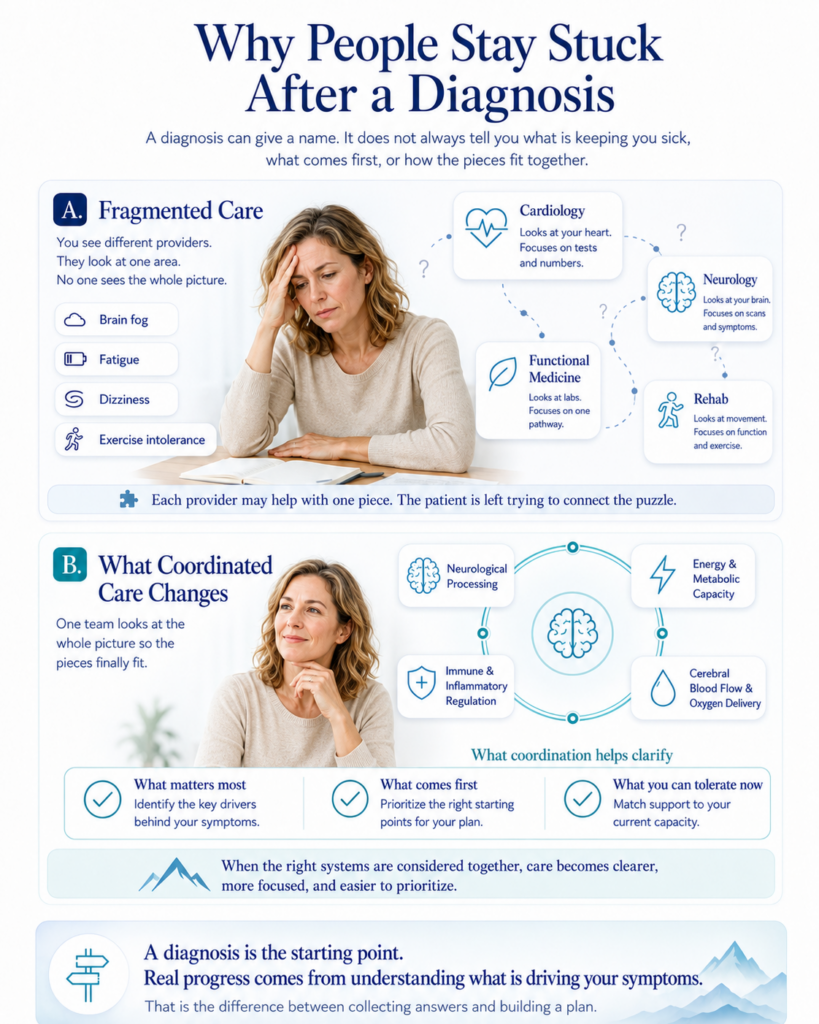
Complex neurological and autonomic conditions rarely involve one isolated system. Yet patients are often evaluated one piece at a time.
Cardiology may focus on heart rate and blood pressure. Neurology may rule out major disease. Functional medicine may evaluate hormones, inflammation, nutrition, immune function, or gut health. Rehabilitation may address balance, vision, movement, or exercise.
Each perspective can provide value.
The problem is that no one may be connecting the findings.
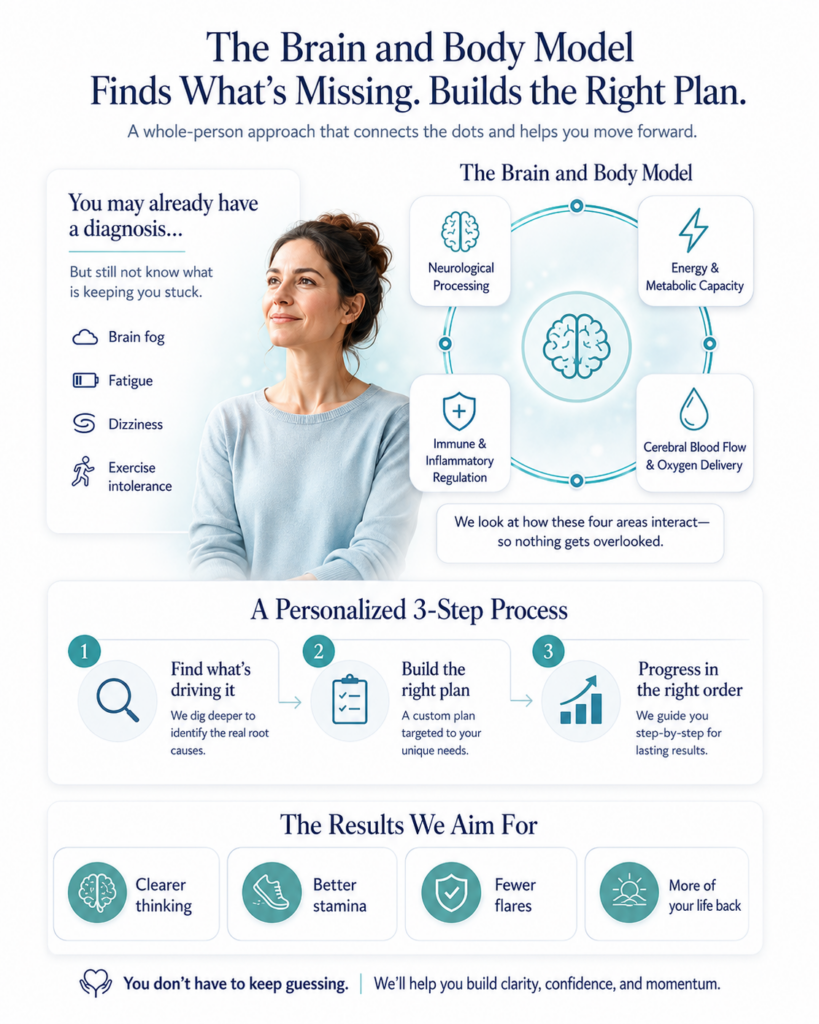
At Peak Brain and Body, we use one framework to evaluate how the brain and body are functioning together. We call it the Brain and Body Model.
It is built around four interconnected areas:
The goal is not to make one abnormality explain every symptom. It is to identify the combination of problems most relevant to your case and determine what should be addressed first.
Your brain continuously receives information from your eyes, inner ears, muscles, joints, sensory systems, and internal organs.
It must organize that information and coordinate an appropriate response within fractions of a second.
When these systems are not functioning efficiently, ordinary activities can require far more neurological effort than they should. This may contribute to brain fog, headaches, dizziness, visual sensitivity, poor balance, motion intolerance, cognitive fatigue, and feeling overwhelmed in busy environments.
Neurological processing is rarely discussed in either traditional or alternative medicine.
Traditional neurological evaluations are often designed to identify or rule out major disease. Alternative approaches usually focus on metabolic, hormonal, immune, nutritional, or gastrointestinal factors that may affect the brain.
Both can be valuable, but neither necessarily measures how efficiently the brain is processing information in real time.
This can make the concept feel unfamiliar, even though the systems involved are well established in neuroscience. They influence how you move your eyes, maintain balance, process your surroundings, concentrate, and adapt to physical or cognitive demands.
Patients may not feel a specific eye-movement or vestibular problem. They simply notice that reading, driving, conversations, stores, exercise, or ordinary daily activities require too much effort.
In our clinical population, approximately 80% of the patients we evaluate demonstrate impaired neurological function that is playing a meaningful role in their symptoms.
Functional medicine can evaluate factors that affect the brain. It does not directly evaluate brain function through oculomotor, vestibular, balance, sensory-integration, and cognitive-motor testing.
For some patients, metabolic or immune care provides meaningful improvement. For others, progress remains limited until neurological dysfunction is addressed directly.
[Learn more about our Functional Neurology approach.]
The brain requires a tremendous amount of energy.
Every thought, movement, autonomic adjustment, and recovery process depends on the ability to produce and use energy efficiently.
When metabolic capacity is reduced, the brain has less reserve. Tasks that should be simple can become exhausting.
Depending on the patient, we may evaluate factors involving iron, thyroid function, blood sugar, nutrients, hormones, stress physiology, oxygen-carrying capacity, and metabolic function.
Improving these areas can increase a patient’s ability to think, move, exercise, and respond to treatment.
But metabolic support does not replace neurological rehabilitation when the brain itself is processing information inefficiently.
[Learn more about our Functional Medicine approach.]
The life-changing improvements that come from optimizing brain health through functional neurology remain one of the most misunderstood and underutilized approaches in all of healthcare. The brain doesn’t have to be an organ we fear it’s an organ that responds when you have a provider who truly seeks to understand it and knows how to leverage the benefits of getting it healthy.
The immune system and nervous system communicate continuously.
Persistent immune activation can affect cognitive function, autonomic regulation, energy production, sleep, pain, vascular function, and exercise tolerance.
This may be particularly relevant for people with Long COVID, ME/CFS, MCAS, autoimmune disease, or post-infectious dysautonomia.
We do not assume that every patient has the same immune trigger. We evaluate whether immune or inflammatory dysfunction is contributing to the larger picture and whether addressing it is likely to change function.
The event that triggered a condition and the factors preventing recovery are not always the same.
Reducing inflammation may help, but it does not automatically retrain neurological systems that have become dysfunctional.
The brain depends on a stable supply of blood, oxygen, glucose, and nutrients.
When cerebral blood flow becomes inconsistent, patients may experience brain fog, dizziness, head pressure, fatigue, exercise intolerance, worsening symptoms while upright, and improvement when lying down.
This is especially important in conditions such as POTS, dysautonomia, Long COVID, ME/CFS, and persistent concussion symptoms.
Heart rate is only one part of the picture.
Blood flow to the brain may also be affected by autonomic regulation, blood volume, vascular tone, breathing patterns, oxygen-carrying capacity, cardiac output, and metabolic demand.
This is why improving a heart-rate number does not always restore cognition, exercise capacity, or tolerance to standing.
These are not four separate programs.
Each area influences the others.
Poor cerebral blood flow can reduce cognitive and physical capacity. Neurological inefficiency can increase energy demand. Immune activation can impair metabolic and autonomic function. Low metabolic capacity can reduce tolerance for rehabilitation.
This is why an appropriate treatment may still fail when it is introduced at the wrong time, at the wrong intensity, or without addressing another major limitation.
A patient may be told to exercise before their neurological processing and cerebral blood flow can tolerate it. Another may begin neurological rehabilitation without enough metabolic capacity to recover. Another may address inflammation while continuing to overload an impaired visual or vestibular system every day.
The treatment may not be wrong.
The sequence may be wrong.
Integration does not simply mean offering multiple therapies in one building.
It means every part of the plan is guided by the same clinical reasoning.
At Peak Brain and Body, neurological, metabolic, immune, autonomic, and blood-flow findings are interpreted together.
That helps us determine:
Many patients would otherwise need to visit several clinics to access these perspectives. Even then, each provider may understand only one part of the case.
Our goal is to create one coordinated explanation and one prioritized plan.
Two people with the same diagnosis may have very different neurological findings, metabolic limitations, immune patterns, and blood-flow challenges.
The diagnosis helps guide the questions.
The evaluation determines the plan.
The Brain and Body Model helps us identify which systems are involved, what may be preventing progress, what you can tolerate now, and what should be addressed first.
This is not a standardized protocol.
It is a clinical reasoning framework built for people with complex, overlapping neurological and autonomic conditions.
At our clinic, we prioritize safety, necessity, informed consent, and coordination of care at all times. Any adjunctive therapies we recommend are case-specific and closely monitored to ensure your well-being.
A diagnosis names your condition, but it does not explain every neurological, autonomic, immune, metabolic, and blood-flow problem that may be contributing to your symptoms.
People with the same diagnosis can have very different combinations of dysfunction, which is one reason they may respond differently to care.
At Peak Brain and Body, we use the Brain and Body Model to evaluate which systems may be contributing most, what may be limiting your progress, and how care should be prioritized. Your diagnosis becomes the starting point—not the entire treatment plan.
Treatments often improve one legitimate part of the problem while leaving other important systems unaddressed.
Fluids, salt, medication, exercise, supplements, dietary changes, or immune support may help without fully resolving brain fog, dizziness, fatigue, exercise intolerance, or recurring symptom flares.
The previous treatment may not have been wrong. It may have been incomplete, poorly sequenced, or more than your system could tolerate at that stage.
The Brain and Body Model was built specifically for people with complex, overlapping conditions such as POTS, dysautonomia, Long COVID, ME/CFS, persistent concussion symptoms, MCAS, and EDS.
These conditions can involve different combinations of neurological processing problems, metabolic limitations, immune dysregulation, autonomic dysfunction, and impaired cerebral blood flow.
Instead of applying the same protocol to everyone with the same diagnosis, we evaluate which factors appear most significant in your individual case and build care around those findings.
Yes. When the brain is not efficiently processing visual, vestibular, sensory, cognitive, and autonomic information, ordinary activities may require more energy and provoke symptoms more easily.
This can contribute to brain fog, dizziness, cognitive fatigue, sensory overload, or worsening symptoms after physical or mental activity.
This does not mean your symptoms are “in your head.” It means impaired neurological function may be an important missing piece, especially when other approaches have provided only partial improvement.
Seeing multiple specialists can provide more information, but it does not automatically create one integrated plan.
Each provider may focus on a different system, leaving you to determine how the findings and recommendations fit together.
At Peak Brain and Body, neurological, metabolic, immune, autonomic, and blood-flow findings are interpreted through one Brain and Body Model. This helps us determine what matters most, what should come first, and how the different parts of care should work together.
No. We do not use a one-size-fits-all program for POTS, Long COVID, concussion, ME/CFS, MCAS, EDS, or other diagnoses.
Your diagnosis guides the questions we ask, but your history, prior testing, objective findings, current capacity, and response to care help determine your plan.
Two people with the same diagnosis may receive very different recommendations.
Yes. This is one of the most common situations we see.
Normal MRI, CT, and routine bloodwork can help identify or rule out major disease and common laboratory abnormalities. However, they do not always measure how efficiently the brain is processing information, how well the autonomic nervous system is regulating, or whether oculomotor, vestibular, balance, and sensory-integration problems are contributing to your symptoms.
Normal results do not mean your symptoms are not real or that nothing is wrong. They may mean that important areas of function have not yet been evaluated.
You do not need to figure that out before contacting us. That is exactly what the Testing Roadmap & Fit Check is designed to help determine.
We review your diagnosis, symptoms, prior testing, and what you have already tried. From there, we determine whether our approach fits your case and what level of evaluation makes the most sense.
The goal is to identify what information is still missing—not to perform every available test on every patient.
Peak Brain and Body is an out-of-network, cash-pay clinic and does not bill insurance directly.
HSA and FSA funds may be used for eligible services, and CareCredit is available for qualified patients. We also provide superbills for patients who wish to submit their care to their insurance company for possible out-of-network reimbursement.
Our team will explain the expected costs and available payment options before you decide whether to move forward.
If you are tired of short visits, normal tests, and treatments that address one symptom at a time, the Brain and Body Model offers a more coordinated way forward.
We evaluate neurological function alongside metabolic, immune, autonomic, and blood-flow factors to identify what may be keeping you stuck, what matters most, and what should be addressed first.
New patients begin with the Testing Roadmap & Fit Check, where we review your history, previous testing, symptoms, and what you have already tried. If our approach fits your case, the next steps may include a comprehensive evaluation, focused testing, a detailed report of findings, and a personalized local or travel care plan.
Call 813-838-4005 or begin the online process to see whether the Brain and Body Model is the right next step for you.
Medically Reviewed by: Spencer Zimmerman, FNP-C, DC, DACNB.
Last Updated: July 28, 2026
At our dedicated doctor’s office, we take immense pride in the care and service we provide to our patients. Here, you can discover the genuine experiences and heartfelt feedback from those who have entrusted us with their health and well-being. These testimonials offer valuable insights into the compassionate and expert care that defines our practice. We are grateful for the trust our patients place in us and invite you to explore their stories, which reflect the exceptional standard of healthcare we aim to deliver every day.
Finally unravel the mysteries of your brain health issues so you can pave the way to lasting clarity and well-being by scheduling a time to speak with our team.