
Integrated Brain & Body Care in Wesley Chapel, Florida
You get through the day but it costs more than it should. You need naps you never used to need. Your brain feels like it is operating through static by mid-afternoon and by evening you have nothing left.
You have been to your doctor. Your labs came back normal. And somewhere along the way you were told it is probably stress, the demands of parenting on top of working, your weight, or just getting older.
You know that is not the full story. What most patients do not realize is that the labs that actually matter often were never run. A thyroid panel that only checks TSH misses how well your thyroid is converting. A ferritin in range may still be too low to support cognitive function. And the neurological drivers of brain fog and fatigue are almost never evaluated at all.
The standard workup finds disease. It is not designed to find functional inefficiency. When you fall between those two categories, you get told you are fine when you are clearly not.
If any of this sounds familiar, you are in the right place:
Brain fog and chronic fatigue are signals that one or more systems are not working efficiently. In most cases more than one system is involved at the same time, which is why addressing only one thing rarely produces lasting results.
Below are the four areas we evaluate systematically. Each one represents a category of conditions and drivers that can produce what you are experiencing. Click through to any that resonate to learn more.
This is where most people start, and for good reason. Thyroid conversion, iron and ferritin levels, blood sugar regulation, and hormonal patterns all directly affect how much energy you have and how clearly you think. The standard workup almost never goes far enough to find the functional inefficiency that drives these symptoms. Conditions and drivers in this category include:
→ Thyroid dysfunction and Hashimoto’s
→ Anemia: Iron deficiency and low ferritin
→ Blood sugar dysregulation and insulin resistance
→ Hormonal imbalance including perimenopause and menopause
→ Adrenal dysfunction
Chronic low-grade inflammation places a direct burden on the brain. When the immune system is chronically activated, it impairs cognitive processing and depletes energy. The gut is one of the primary drivers of this immune burden, and many patients have normalized gut symptoms that are contributing significantly to how they feel. Conditions and drivers in this category include:
→ Gut dysbiosis and intestinal permeability
→ Food sensitivities and chronic immune activation
→ Mast cell activation syndrome (MCAS)
→ Autoimmune conditions
→ Post-viral immune dysregulation including Long COVID
→ Mold and biotoxin illness
The brain requires consistent blood flow and oxygen to function. When autonomic regulation is off, blood and oxygen delivery to the brain becomes inconsistent. This is why so many patients with brain fog and fatigue feel worse when upright, worse after meals, and better lying down. Those are not random patterns. Conditions and drivers in this category include:
→ POTS and dysautonomia
→ Orthostatic intolerance and subclinical autonomic dysregulation
→ Cardiovascular and circulatory inefficiency
→ Anemia and oxygen-carrying capacity
This is the area almost nobody evaluates for brain fog and fatigue patients, and it is often where the most significant and most treatable findings live. The brain works harder than it should when neurological processing is inefficient, consuming energy that leaves nothing for the rest of the day. Conditions and drivers in this category include:
→ Oculomotor and vestibular processing inefficiency
→ Post-concussion syndrome
→ ME/CFS and neurological capacity limitations
→ Ehlers-Danlos syndrome and proprioceptive dysfunction
→ Neurological contributions from POTS and dysautonomia
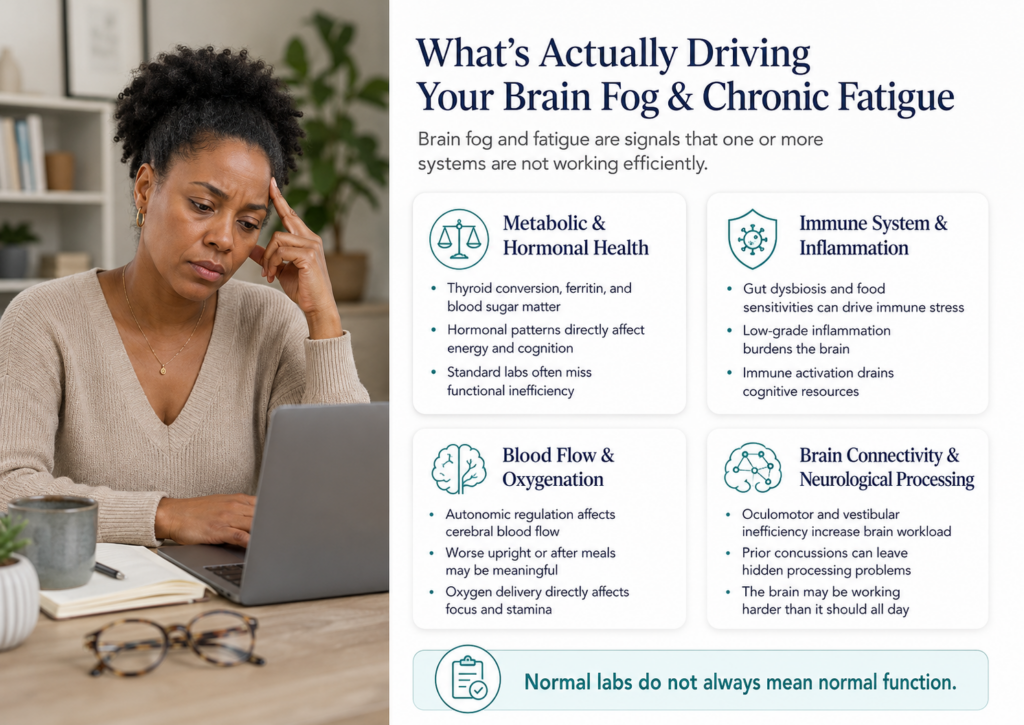
We do not start with assumptions about what is driving your symptoms. We evaluate each of the four systems above to identify what is actually contributing to your specific presentation. That evaluation includes:
Advanced oculomotor and vestibular testing gives us measurable data on how your brain is processing and regulating. This is not an MRI or a standard cognitive screen. It tells us where your neurological processing is inefficient and how much of a metabolic burden that inefficiency is placing on your brain every day.
We go beyond the standard panel to evaluate thyroid function and conversion, ferritin and iron, blood sugar patterns, hormonal profiles including estrogen, progesterone, testosterone, DHEA, and cortisol, adrenal function, and inflammatory markers. We are looking for functional inefficiency, not just disease, which means we interpret ranges differently than a standard lab report.
Where the history and pattern point toward immune dysregulation, gut health, food sensitivities, or post-viral burden, we evaluate those specifically. These are not run on every patient but they are an important part of the picture for many patients who have been stuck despite addressing metabolic and neurological factors alone.
We assess how well your autonomic nervous system is regulating blood flow and oxygenation, including whether orthostatic changes are contributing to your cognitive and energy symptoms throughout the day. Many patients with brain fog and fatigue have subclinical autonomic dysregulation that has never been identified because it does not meet the threshold for a formal POTS diagnosis but is still meaningfully affecting function.

Your care plan is determined entirely by your evaluation results. Most patients follow one of three paths:
Metabolic and Functional Medicine – Focused Path
Best when driven by:
Neurology-Focused Path
Best when driven by:
Combined Brain-Body Path (most common)
Most brain fog and chronic fatigue patients benefit from a coordinated approach combining:
We pace care carefully around your current capacity and energy limits. Treatment intensity is calibrated to produce improvement without depleting the reserves you need to function. All medications and supplements are reviewed to ensure they are appropriate and not adding to the burden on your system.
Fatigue that does not improve with adequate sleep is almost never about sleep itself. It is about what is happening while you are awake. Neurological processing inefficiency, autonomic dysregulation affecting blood flow, metabolic dysfunction limiting energy production, and chronic immune activation all consume resources throughout the day in ways that sleep cannot replenish. Identifying which of these systems is most burdened is where the evaluation needs to start.
Yes. Brain fog has measurable physical causes including thyroid conversion issues, low ferritin, blood sugar instability, autonomic dysregulation reducing cerebral blood flow, oculomotor and vestibular processing inefficiency, and chronic inflammatory burden. These are not psychological. They show up on objective testing and they respond to targeted treatment. Stress can amplify these issues but it is rarely the primary driver.
The most common underlying conditions in our patient population include POTS and dysautonomia, ME/CFS, Long COVID, MCAS, EDS, post-concussion syndrome, thyroid dysfunction including Hashimoto’s, hormonal imbalance particularly around perimenopause and menopause, and gut dysbiosis creating chronic immune activation. Many patients present with more than one of these simultaneously, which is exactly why a multi-system evaluation is necessary.
Yes. This is one of the most commonly missed contributors to brain fog and chronic fatigue. A concussion from years or even decades ago can leave lasting inefficiencies in oculomotor and vestibular processing that nobody has ever connected to how you feel today. The initial injury may have seemed to resolve but the neurological processing changes can persist indefinitely without targeted rehabilitation. Many patients are surprised to discover that a head injury from high school, a car accident, or a fall that seemed minor at the time is a significant driver of their current symptoms.
Yes and this is one of the most common presentations we see. Thyroid dysfunction affects how efficiently the brain produces energy. Estrogen and progesterone fluctuations directly affect neurological threshold, cognitive clarity, and energy regulation. Low testosterone affects motivation, cognitive sharpness, and physical stamina in both men and women. Cortisol dysregulation from adrenal stress impairs both cognitive function and energy production. The challenge is that standard hormone panels often miss functional inefficiency, showing levels that are technically in range but not adequate for optimal brain function.
Standard primary care evaluations are designed to identify disease, not functional inefficiency. TSH alone does not tell you how well the thyroid is converting. A ferritin in the normal range may still be too low to support cognitive function. Standard cognitive testing does not measure neurological processing speed or oculomotor efficiency. And autonomic function is almost never evaluated in primary care unless symptoms are severe enough to suggest a formal POTS diagnosis. We evaluate what your doctor likely did not measure, interpret findings in the context of optimal function rather than disease thresholds, and add objective neurological testing that standard medicine does not perform.
No. Many of our patients come in without a clear diagnosis. They know something is wrong, their quality of life has changed, and nobody has been able to explain why. Our evaluation is designed to identify what is driving your symptoms regardless of whether you have a label for them. Some patients leave with a clearer understanding of an underlying condition they never knew they had. Others find that the issue is functional inefficiency across multiple systems without a single diagnostic category. Either way the plan is built around what your evaluation shows, not what your chart says.
Step 1 — Complimentary Intake Call
A conversation with our patient coordinator to learn about your history, answer your questions, and determine whether we are the right fit. For out-of-state patients, program options and pricing are discussed at this stage.
Step 2 — Provider Consultation
A clinical conversation with Dr. Zimmerman. You will complete intake paperwork beforehand so this is a real clinical conversation from the start, not an introduction. A fee is charged for this visit and is applied toward your care if you move forward.
Step 3 — Precision Evaluation
Targeted neurological, autonomic, and comprehensive metabolic and hormonal testing to identify exactly what is driving your symptoms and which systems are most contributing.
Step 4 — Report of Findings
A clear, specific plan built around your data. Not a generic fatigue protocol. A plan built from what your evaluation actually shows.
If brain fog and chronic fatigue have left you functioning at a fraction of what you should be, and every provider you have seen has told you your labs are normal without actually looking at what drives your symptoms, there is a reason things have not changed. The labs that matter often were never run. The systems that need to be evaluated often were never assessed. That changes here.
Call 813-838-4005 or start the process online to see if we are the right fit.
Samuels MH, Bernstein LJ. Brain fog in hypothyroidism: what is it, how is it measured, and what can be done about it. Thyroid. 2022;32(7):752-763. doi:10.1089/thy.2022.0139
Zhu J, Xu J, Li Z, Liu J. Association of overt hypothyroidism with risks of cognitive impairment: a meta-analysis and systematic review. Frontiers in Endocrinology. 2025;16:1643589. doi:10.3389/fendo.2025.1643589
Edgell H, et al. Autonomic phenotyping, brain blood flow control, and cognitive-motor-integration in Long COVID and myalgic encephalomyelitis/chronic fatigue syndrome: A pilot study. Autonomic Neuroscience. 2025. doi:10.1016/j.autneu.2025.103208
Tavee J. Current concepts in long COVID-19 brain fog and postural orthostatic tachycardia syndrome. Annals of Allergy, Asthma and Immunology. 2024;133(5):522-530. doi:10.1016/j.anai.2024.08.008
NIH ME/CFS Research Roadmap Working Group. Report of the ME/CFS Research Roadmap Working Group of Council. National Institute of Neurological Disorders and Stroke. May 2024.
Wilson JC, Liu KY, Mittelman E, et al. Brain fog with long covid and chemotherapy: systematic review and meta-analysis. BMJ Mental Health. 2025. doi:10.1136/bmjment-2025-301969
You may also want to read about POTS and Dysautonomia, ME/CFS, Mast Cell Activation Syndrome, Post-Concussion Syndrome, Headaches and Migraines, Metabolic and Hormonal Health, Functional Neurology, and Lab Testing, since these conditions and evaluation tools directly overlap with brain fog and chronic fatigue and are frequently part of the full picture we evaluate and treat together.
Medically Reviewed by: Spencer Zimmerman, FNP-C, DC, DACNB
Last Updated: June 28, 2026
At our dedicated doctor’s office, we take immense pride in the care and service we provide to our patients. Here, you can discover the genuine experiences and heartfelt feedback from those who have entrusted us with their health and well-being. These testimonials offer valuable insights into the compassionate and expert care that defines our practice. We are grateful for the trust our patients place in us and invite you to explore their stories, which reflect the exceptional standard of healthcare we aim to deliver every day.
Finally unravel the mysteries of your brain health issues so you can pave the way to lasting clarity and well-being by scheduling a time to speak with our team.