
Integrated Brain & Body Care in Wesley Chapel, Florida
You have tried the medications. Some helped a little. Most either stopped working, caused side effects, or never worked at all. You have done chiropractic and your neck felt better temporarily but the headaches kept coming. You have tried massage, physical therapy, maybe dietary changes. And you are still here, still dealing with headaches that are too frequent, too severe, or too unpredictable to ignore.
The providers you have seen have each had an explanation. Your neck is tight and your cervical spine is misaligned. You have migraine disorder and here is a prescription. Your gut is inflamed and your diet needs to change. Each of them was partially right. The problem is that headaches and migraines are almost never caused by just one thing. And when only one thing gets addressed, the results reflect that.
You know that what you are experiencing is not stress, not depression, and not deconditioning. You know your body and you know something is genuinely wrong. And you have been told so many times that nothing is wrong that you may have started to doubt yourself, even though you never stopped knowing the truth.
The fatigue you feel is not the same as being tired and no amount of sleep fixes it. Activity, whether physical or cognitive, makes everything worse in a way that most people around you cannot understand. A conversation, a car ride, a trip through a grocery store, things that should cost nothing leave you wiped out for hours or days afterward.
That is not a psychological problem. That is a measurable neurological and metabolic problem. And it is exactly what we evaluate and treat.
If any of this sounds familiar, you are in the right place:
Headaches and migraines are symptoms. They are the output of one or more systems that are not functioning the way they should. The reason treatment so often fails is that most providers evaluate and treat only one system when several are almost always involved simultaneously.
Below are the four areas we evaluate systematically. Each one represents a category of conditions and drivers that can produce what you are experiencing. Click through to any that resonate to learn more.
The vestibular system, oculomotor system, and the brain’s ability to process movement and visual input are the most commonly missed drivers of chronic headaches and migraines. When these systems are not functioning efficiently, the brain works harder than it should and produces head pressure, pain, light sensitivity, and motion sensitivity that does not respond to standard migraine medications. The neck is almost always a manifestation of this problem, not the source of it. Conditions and drivers in this category include:
→ Post-Concussion Syndrome
→ Dizziness and Vertigo
→ Binocular Vision Dysfunction
→ Functional Neurology
→ POTS and Dysautonomia with vestibulo-autonomic involvement
The autonomic nervous system regulates blood vessel tone and cerebral blood flow. When autonomic regulation is off, blood flow to the brain becomes inconsistent and directly triggers or amplifies headaches and migraines. Many headache patients have subclinical autonomic dysregulation that has never been identified because nobody connected the headaches to the blood flow picture. Conditions and drivers in this category include:
→ POTS and Dysautonomia
→ Long COVID with autonomic involvement
→ Ehlers-Danlos Syndrome affecting vascular tone
Hormonal fluctuations are among the most well-recognized headache triggers. Estrogen and progesterone changes throughout the cycle, perimenopause, and menopause directly affect neurological threshold and vascular tone. Blood sugar instability, thyroid dysfunction, and key nutrient deficiencies including magnesium, B vitamins, and ferritin all influence how frequently and severely headaches occur. Conditions and drivers in this category include:
→ Metabolic and Hormonal Health
→ Thyroid and Hashimoto’s
→ Blood sugar dysregulation
→ Functional Medicine
The gut-brain connection is real and relevant for headache patients. Gut dysbiosis, intestinal permeability, and food sensitivities can all contribute to systemic inflammation that lowers the threshold for headaches and migraines. This is a real piece of the picture for some patients. It is rarely sufficient on its own but when addressed as part of a comprehensive plan consistently improves headache frequency beyond what gut treatment alone produces. Conditions and drivers in this category include:
→ Gastrointestinal Health
→ Mast Cell Activation Syndrome
→ Autoimmune Conditions
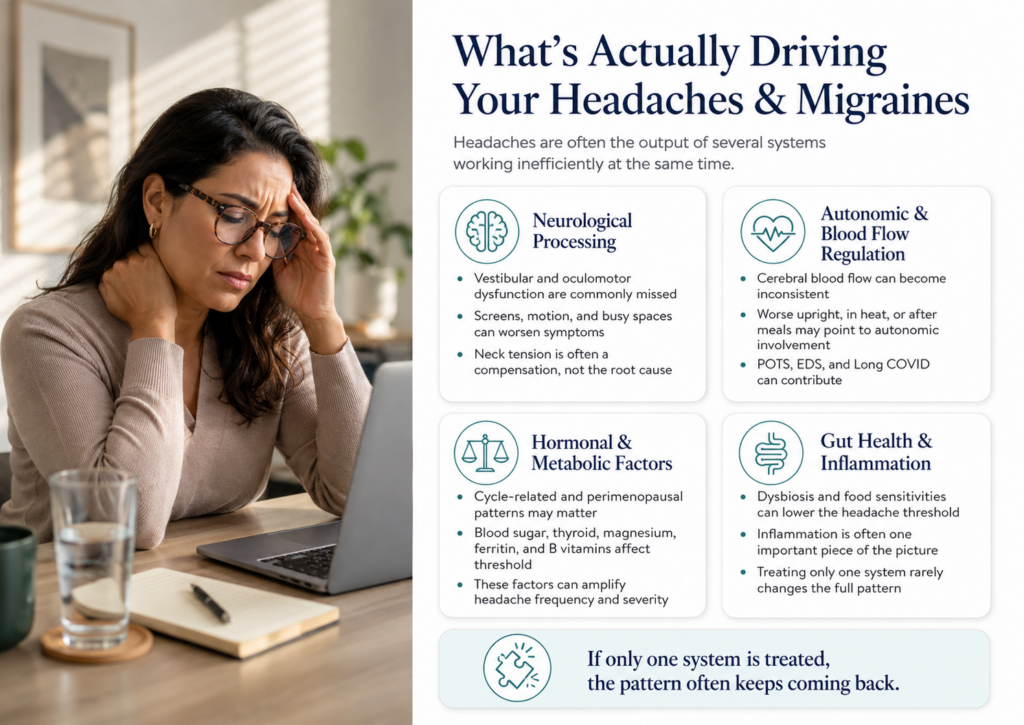
We do not start with assumptions about what is driving your headaches. We evaluate each of the four systems above to identify what is actually contributing to your specific presentation. That evaluation includes:
Advanced oculomotor and vestibular testing gives us measurable data on how your brain is processing movement, visual input, and spatial orientation. This is the testing that identifies the neurological drivers most providers never evaluate. It tells us whether vestibular or oculomotor inefficiency is generating your headaches and how significantly it is contributing to your pattern.
We assess how well your autonomic nervous system is regulating blood flow and whether orthostatic changes are contributing to your headache pattern. Many headache patients have subclinical autonomic dysregulation that does not meet the formal threshold for a POTS diagnosis but is still meaningfully affecting cerebral blood flow and headache frequency.
We evaluate thyroid function and conversion, key nutrient levels including magnesium, B vitamins, and ferritin, blood sugar regulation, and hormonal patterns including estrogen, progesterone, and cortisol. We are looking for functional inefficiency that is lowering your headache threshold, not just disease-level findings.
Where the history and pattern point toward inflammatory burden, food sensitivities, or gut dysbiosis as contributing factors, we evaluate those specifically. These are not run on every patient but are an important piece for patients whose headache patterns include clear dietary triggers or systemic immune symptoms.

Your care plan is determined entirely by your evaluation results. Most patients follow one of three paths:
Neurology-Focused Path
Best when driven by:
Functional Medicine-Focused Path
Best when driven by:
Combined Brain-Body Path (most common)
Most headache and migraine patients benefit from a coordinated approach combining:
We evaluate the vestibular and oculomotor systems that no other headache provider is assessing
We pace care carefully around your headache threshold and symptom sensitivity. For patients with significant light or motion sensitivity, treatment is calibrated to avoid triggering headaches during the rehabilitation process. If needed, we co-manage or triage red flags including sudden severe headache, neurological changes, or presentations that require additional specialist involvement. All medications and supplements are reviewed to ensure they are appropriate and not contributing to medication overuse headache.
The vestibular and oculomotor systems connect directly to the cervical musculature through reflex pathways. When those systems are dysregulated, the suboccipital muscles and upper cervical spine stay in a state of chronic tension as a compensatory response. This is why chiropractic and massage produce temporary relief but the tension returns. The neck is responding to a neurological driver that has not been addressed. When the vestibular and oculomotor systems are treated directly, cervical tension consistently improves without any direct neck treatment.
The oculomotor system controls how the eyes move and how the brain integrates visual information. When this system is not functioning efficiently, the brain works significantly harder to process visual input, movement, and changing environments. That extra neurological effort generates head pressure, pain, and light sensitivity that is indistinguishable from migraine in terms of how it feels but does not respond to vascular or chemical migraine treatments because the mechanism is different. This is why screen time, bright environments, and visually busy spaces are among the most common headache triggers.
Migraine medications target specific chemical and vascular pathways. When the primary driver of headaches is vestibular or oculomotor processing inefficiency, autonomic dysregulation, or a combination of metabolic factors, those pathways are not the primary mechanism. Medications designed for one mechanism rarely produce lasting results when the actual driver is different. This is one of the most common reasons patients with frequent headaches cycle through multiple medications without finding something that works consistently.
Yes, and more often than most patients realize. POTS and dysautonomia produce autonomic dysregulation that directly affects cerebral blood flow and headache threshold. EDS affects vascular tone, proprioception, and autonomic regulation in ways that commonly produce headaches. A prior concussion, even one from years ago, can leave vestibular and oculomotor processing inefficiencies that generate ongoing headaches that nobody has ever connected to the original injury. If you have any of these
Yes. Hormonal patterns including estrogen and progesterone fluctuations across the menstrual cycle, perimenopause, and menopause directly affect neurological threshold, vascular tone, and inflammatory response. We evaluate hormonal patterns as part of the comprehensive picture and address them as a contributing factor rather than the sole explanation, because in most patients hormonal triggers are amplified by other system inefficiencies that lower the baseline threshold.
Yes, particularly when headaches are part of a larger pattern involving POTS, EDS, post-concussion syndrome, or other neuroimmune conditions. The intensive format allows us to evaluate and address multiple contributing systems in a concentrated period rather than working through them one at a time over months of appointments.
Step 1 — Complimentary Intake Call
A conversation with our patient coordinator to learn about your history, answer your questions, and determine whether we are the right fit. For out-of-state patients, program options and pricing are discussed at this stage.
Step 2 — Provider Consultation
A clinical conversation with Dr. Zimmerman. You will complete intake paperwork beforehand so this is a real clinical conversation from the start, not an introduction. A fee is charged for this visit and is applied toward your care if you move forward.
Step 3 — Precision Evaluation
Targeted neurological, vestibular, oculomotor, and autonomic testing alongside metabolic and hormonal evaluation to identify exactly what is driving your headache pattern.
Step 4 — Report of Findings
A clear, specific plan built around your data. Not a headache protocol. A plan built from what your evaluation actually shows about which systems are driving your symptoms.
If headaches and migraines have been limiting your life and everything you have tried has only managed the pain without changing how often it comes back, there is a reason. The cervical spine is not the source. The medication is not the answer. The system driving your headaches has likely never been fully evaluated. That is where we start.
Call 813-838-4005 or start the process online to see if we are the right fit.
Ashina M, et al. Migraine: epidemiology and systems biology. Brain. 2019;142(9):2672-2686. doi:10.1093/brain/awz160
Balaban CD, Yates BJ. What is the link between dizziness and vestibular dysfunction and migraine? Frontiers in Neurology. 2017;8:377. doi:10.3389/fneur.2017.00377
Calhoun AH, Ford S. Behavioral sleep modification may revert transformed migraine to episodic migraine. Headache. 2007;47(8):1178-1183. doi:10.1111/j.1526-4610.2007.00780.x
Diener HC, et al. Non-pharmacological interventions for the prevention and treatment of migraine: a systematic review. Cephalalgia. 2022;42(1):48-65. doi:10.1177/03331024211035616
Tavee J. Current concepts in long COVID-19 brain fog and postural orthostatic tachycardia syndrome. Annals of Allergy, Asthma and Immunology. 2024;133(5):522-530. doi:10.1016/j.anai.2024.08.008
Blitshteyn S. Dysautonomia, hypermobility spectrum disorders and mast cell activation syndrome as migraine comorbidities. Current Neurology and Neuroscience Reports. 2023;23(11):769-776. doi:10.1007/s11910-023-01307-w
You may also want to read about POTS and Dysautonomia, Post-Concussion Syndrome, Ehlers-Danlos Syndrome, Dizziness and Vertigo, Long COVID, Functional Neurology, and Lab Testing, since these conditions and evaluation tools directly overlap with headaches and migraines and are frequently part of the full picture we evaluate and treat together.
Medically Reviewed by: Spencer Zimmerman, FNP-C, DC, DACNB
Last Updated: June 28, 2026
At our dedicated doctor’s office, we take immense pride in the care and service we provide to our patients. Here, you can discover the genuine experiences and heartfelt feedback from those who have entrusted us with their health and well-being. These testimonials offer valuable insights into the compassionate and expert care that defines our practice. We are grateful for the trust our patients place in us and invite you to explore their stories, which reflect the exceptional standard of healthcare we aim to deliver every day.
Finally unravel the mysteries of your brain health issues so you can pave the way to lasting clarity and well-being by scheduling a time to speak with our team.