
Integrated Brain & Body Care in Wesley Chapel, Florida
You may have been flexible your whole life and never thought much of it. It was not a problem. Until something happened. An injury, an illness, a surgery, a pregnancy, or a period of significant stress, and suddenly everything changed. What was just a quirk about your body became the thing that started explaining years of symptoms you never had answers for.
You have been told your connective tissue is the problem. You have hypermobile joints, chronic pain, frequent injuries, and a history of being told to strengthen and stabilize. You have been sent to rheumatology, where the conversation was short and the guidance was minimal. You have done physical therapy, and maybe it helped some things, or maybe it made others worse.
And you are still dealing with dizziness, headaches, brain fog, fatigue, and a nervous system that feels like it is constantly on the edge.
It is worth noting that most people with EDS have the hypermobile type, which does not have a confirmed genetic marker. That means the diagnosis is clinical, based on your history and presentation, and many providers are not comfortable making it or treating it. If you have been told you do not officially have EDS because your genetic testing was normal, that does not mean you do not have it.
The physical therapy did not fix the dizziness. The neck work did not stop the headaches. And nobody has been able to explain why your neurological symptoms are so prominent when your diagnosis is supposed to be about your joints.
Here is what most providers are not telling you: Ehlers-Danlos syndrome is not just a connective tissue problem. It is a neurological and immune problem that happens to manifest in the connective tissue. And when that piece of the picture gets addressed, people do significantly better.
If any of this sounds familiar, you are in the right place:
Most of our EDS patients have been dealing with their symptoms for years before anyone connected the neurological piece to their connective tissue diagnosis. Many were told what they had long before anyone told them what to do about the parts that mattered most.
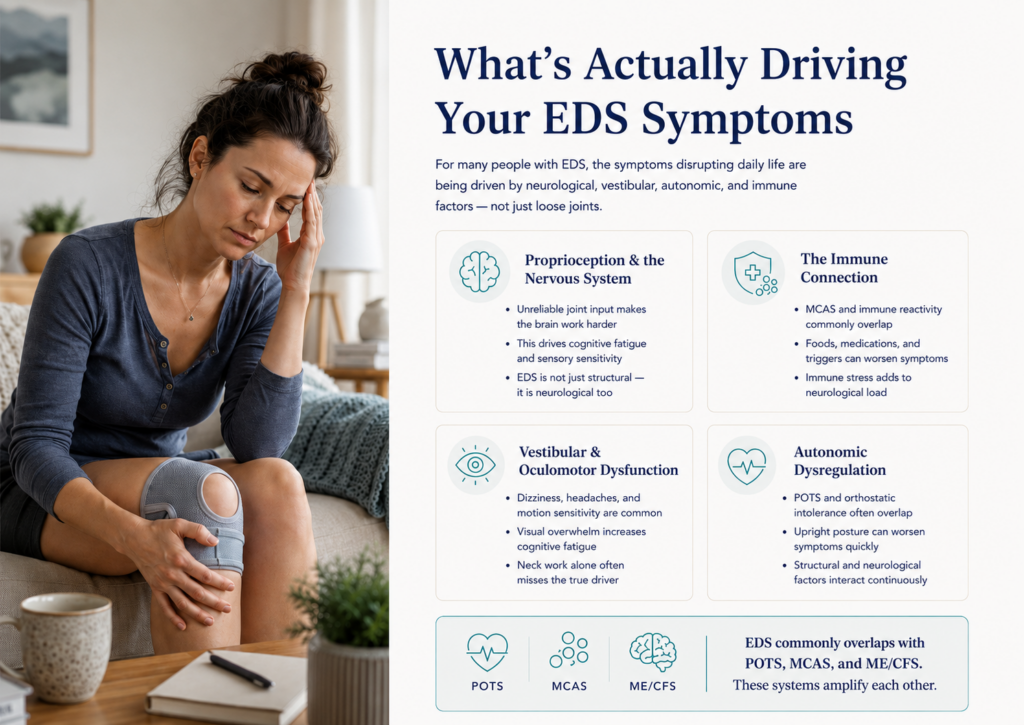
The connective tissue laxity in Ehlers-Danlos syndrome is real. But the symptoms that most impact quality of life are not primarily coming from loose joints. They are coming from how that connective tissue laxity affects the nervous system, the vestibular system, and immune regulation.
The connective tissue laxity in EDS does not just affect your joints. It affects how your body senses where it is in space. Proprioceptive input, the signals your body sends your brain about position and movement, feeds directly into your brain’s regulatory systems. When that input is disrupted or unreliable, your brain works harder to compensate. That extra effort drives cognitive fatigue, sensory sensitivity, and autonomic dysregulation. This is why EDS is not just a structural problem. It is a neurological problem from the ground up.
EDS and mast cell activation syndrome co-occur at a high rate and it is not a coincidence. The same dysregulation that affects connective tissue also affects immune regulation. This is why so many EDS patients react to foods, medications, and environmental triggers, and why their symptoms spike when their immune system is challenged. Addressing the immune component is not separate from treating EDS. It is part of it.
This is the part most providers are not evaluating. Many EDS patients have had extensive work done on their cervical spine and gotten limited results. That is because the neck is frequently a manifestation of the problem, not the source of it. When the vestibular system and oculomotor system are not functioning efficiently, the result is dizziness, headaches, motion sensitivity, visual overwhelm, and cognitive fatigue that no amount of neck work or physical therapy will resolve. When these systems are evaluated and treated directly, patients see improvements that years of structural treatment did not produce.
POTS and dysautonomia co-occur with EDS in a significant proportion of patients. The connective tissue laxity affects blood vessel walls and vascular tone, contributing to blood pooling and orthostatic intolerance. But the neurological regulatory component is equally important and often more directly treatable than the structural piece.
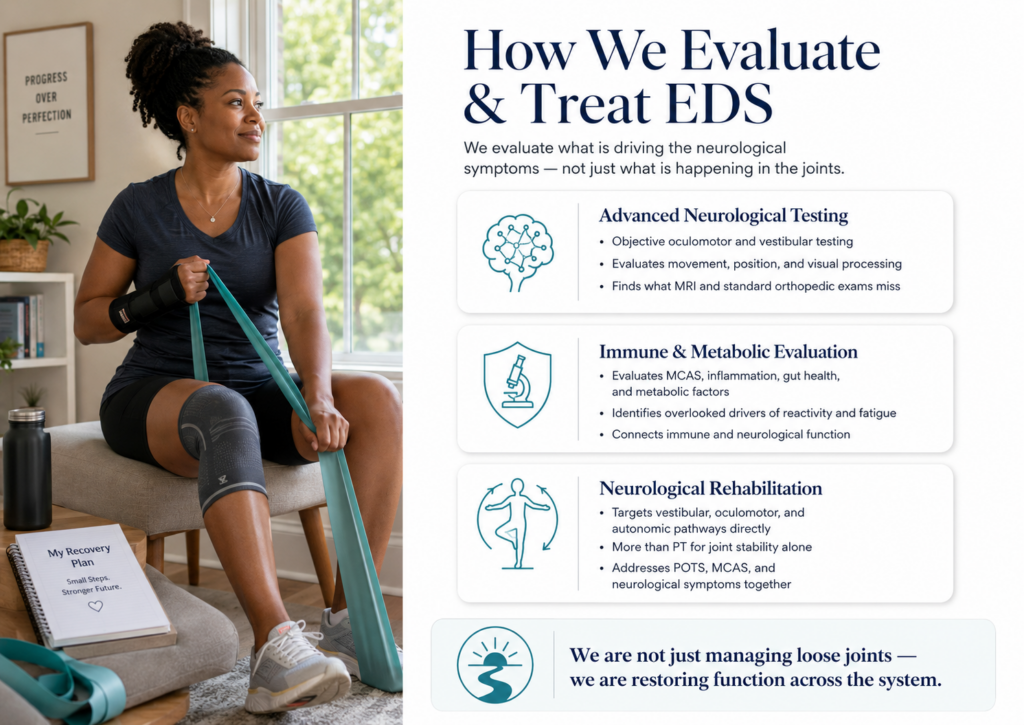
We evaluate what is actually driving your body and neurological symptoms, not just what is happening in your joints.
We use objective oculomotor and vestibular testing to evaluate how your brain is processing movement, position, and visual input. This is functional neurological data that does not appear on an MRI or in a standard orthopedic evaluation. It tells us what your nervous system is actually doing and where it is working inefficiently, which directly maps to the symptoms you experience.
We evaluate for mast cell activation, inflammatory markers, gut health, and metabolic factors that are influencing immune regulation and neurological function. For EDS patients with significant reactivity or immune symptoms, this evaluation frequently identifies drivers that have been completely overlooked.
Treatment targets the vestibular system, oculomotor system, and autonomic regulatory pathways directly. This is not the same as physical therapy for joint stability. It is neurological rehabilitation that addresses the brain’s regulatory dysfunction, which is what produces meaningful improvements in dizziness, headaches, cognitive function, and autonomic stability that structural interventions alone cannot achieve. We treat the co-diagnoses that travel with EDS simultaneously. POTS, MCAS, and the neurological symptoms do not each get their own separate treatment plan. They get addressed together because that is how they actually work in your body.
Your care plan is determined entirely by your evaluation results. Most patients follow one of three paths:
Neurology-Focused Path
Best when symptoms are driven primarily by:
Functional Medicine-Focused Path
Best when symptoms are driven mainly by:
Combined Brain-Body Path (most common)
Most EDS patients benefit from a coordinated approach combining:
We pace care carefully around your energy limits, orthostatic tolerance, and symptom threshold. For EDS patients with significant joint instability or dysautonomia, treatment intensity and positioning are calibrated to avoid exacerbating symptoms. If needed, we co-manage or triage red flags including:
Yes. The hypermobile type of EDS, which is the most common, does not have a confirmed genetic marker. The diagnosis is clinical, meaning it is based on your history, symptoms, and physical presentation. Many patients have been told they do not have EDS because their genetic testing was normal. That is not accurate. A negative genetic test does not rule out hypermobile EDS.
Because EDS is not only a connective tissue condition. The connective tissue laxity affects how your body senses position and movement, how blood vessel walls maintain tone, and how your autonomic nervous system regulates itself. The vestibular system, oculomotor system, and proprioceptive pathways are all impacted, which directly produces dizziness, brain fog, headaches, and cognitive fatigue. These are not secondary symptoms. They are part of the condition.
Because those symptoms are not primarily coming from the structural issues PT addresses. They are coming from vestibular and oculomotor dysfunction that requires neurological rehabilitation, not joint stabilization. When those systems are evaluated and treated directly, patients consistently see improvements that years of physical therapy did not produce. The neck and joints are frequently where the symptoms show up, not where they originate.
These conditions share overlapping mechanisms. The connective tissue laxity in EDS affects blood vessel walls and vascular tone, which drives the orthostatic intolerance that defines POTS. The same immune dysregulation that affects connective tissue integrity also drives mast cell hyperreactivity. They are not separate diagnoses that happen to coexist. They are part of the same dysregulated system, which is why all three need to be addressed together.
Yes. Most of what limits quality of life in EDS patients, the dizziness, headaches, cognitive dysfunction, autonomic instability, and fatigue, is neurological and immune in nature and responds to the right evaluation and treatment. We are not treating the connective tissue laxity itself. We are treating what that laxity does to the nervous system and immune system, which is where meaningful improvement comes from.
Many EDS patients were flexible their whole lives without significant problems until a specific event triggered the onset of more severe symptoms. An injury, viral illness, surgery, or pregnancy can push an already vulnerable nervous system and immune system past a threshold it can no longer compensate for. Understanding what changed and addressing those specific triggers is part of how we approach the evaluation.
Yes. EDS with co-occurring POTS, MCAS, and neurological symptoms is exactly the kind of complex multi-system presentation our out-of-state intensive is designed for. Patients travel from across the country to receive concentrated, one-on-one neurological and functional medicine care that addresses the full picture rather than one diagnosis at a time.
Step 1 — Complimentary Intake Call
A conversation with our patient coordinator to learn about your history, answer your questions, and determine whether we are the right fit.
Step 2 — Provider Consultation
A clinical conversation with Dr. Zimmerman. You will complete intake paperwork beforehand so this is a real clinical conversation from the start, not an introduction. A fee is charged for this visit and is applied toward your care if you move forward.
Step 3 — Precision Evaluation
Targeted neurological, autonomic, and functional medicine testing to identify exactly what is driving your EDS and what else is contributing.
Step 4 — Report of Findings
A clear, specific plan built around your data. Not a protocol. A plan built from your case from the beginning because EDS rarely has a single driver.
If EDS has left you with symptoms that structural treatment has never fully addressed, there is a reason and there is a path forward. Call 813-838-4005 or start the process online to see if we are the right fit.
Bauer ME, Teixeira AL. Mast cells in the autonomic nervous system and potential role in disorders with dysautonomia and neuroinflammation. Annals of Allergy, Asthma and Immunology. 2023;132(4):440-448. doi:10.1016/j.anai.2023.10.032
Blitshteyn S. Dysautonomia, hypermobility spectrum disorders and mast cell activation syndrome as migraine comorbidities. Current Neurology and Neuroscience Reports. 2023;23(11):769-776. doi:10.1007/s11910-023-01307-w
Griggs M, et al. Proteomic discoveries in hypermobile Ehlers-Danlos syndrome reveal insights into disease pathophysiology. ImmunoHorizons. 2025;9(10):vlaf044.
Weinstock LB, Nelson RM, Blitshteyn S. Prevalence and treatment response of neuropsychiatric disorders in mast cell activation syndrome. Brain, Behavior, and Immunity. 2025. doi:10.1016/j.bbi.2025.01.001
You may also want to read about POTS and Dysautonomia, Mast Cell Activation Syndrome, ME/CFS, Dizziness and Vertigo, and Post-Concussion Syndrome, since these conditions and evaluation tools directly overlap with EDS and are almost always part of the full picture we evaluate and treat together.
Medically Reviewed by: Spencer Zimmerman, FNP-C, DC, DACNB
Last Updated: June 28, 2026
At our dedicated doctor’s office, we take immense pride in the care and service we provide to our patients. Here, you can discover the genuine experiences and heartfelt feedback from those who have entrusted us with their health and well-being. These testimonials offer valuable insights into the compassionate and expert care that defines our practice. We are grateful for the trust our patients place in us and invite you to explore their stories, which reflect the exceptional standard of healthcare we aim to deliver every day.
Finally unravel the mysteries of your brain health issues so you can pave the way to lasting clarity and well-being by scheduling a time to speak with our team.